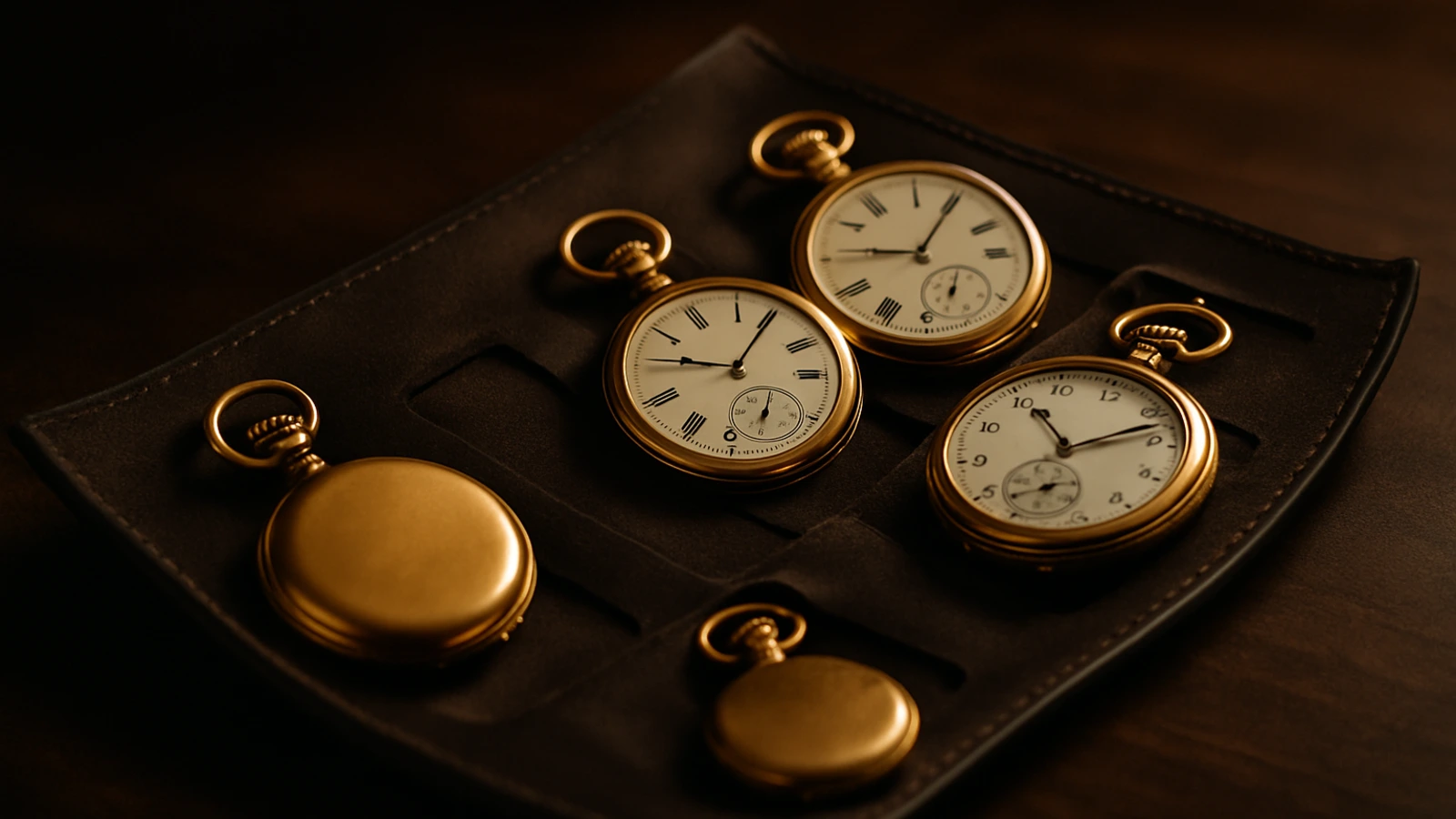
Before you do anything
Most people selling a pocket watch have never sold one before. It usually arrives through a will, a house clearance, or a drawer that finally got sorted. You don't need to become an expert to sell it well. You do need to avoid three mistakes that cost real money, and all three happen in the first week.
- Don't polish it. It feels like the obvious way to smarten it up. On a gold or silver case, polishing softens the hallmarks and engraving that buyers use to assess it, and collectors pay more for untouched surfaces. Wipe off dust with a soft cloth and stop there.
- Don't force anything. Case backs unscrew or pop open in different ways, and a slipped knife leaves a mark that stays. If the back won't open easily, leave it shut. A buyer can work from photographs of the outside.
- Don't overwind it. If it winds freely, a few gentle turns to see whether it ticks is fine. If you feel resistance, stop. A seized movement forced further becomes a broken movement.
Also write down anything you know about the watch's history. Who owned it, roughly when they bought or received it, any paperwork or box in the same drawer. Provenance is one of the few things that can lift a price and costs nothing to record.
The three realistic routes
Route 1: Auction
You consign the watch to an auction house, it goes into a catalogued sale, and you receive whatever it hammers for, minus fees. For genuinely rare watches this is often the right call, because two collectors bidding against each other can beat any dealer's offer.
The costs are the wait and the fees. From consignment to money in your account is typically two to six months, and combined buyer's and seller's premiums can take around 30–45% of the hammer price. There's no guaranteed outcome either: the watch can sell below estimate, or not sell at all and come back to you.
Route 2: A high-street gold or scrap buyer
Walking into a shop gets you a same-day answer and, if you accept, same-day payment. For some people that convenience is worth a lot.
The weakness of this route is what gets assessed. A scrap buyer weighs the case and prices the metal, and that's usually the whole exercise: the movement, the maker and the condition don't enter into it, and the offer arrives as a single number with no explanation. If you go this way, get at least two offers and ask each buyer what their number is based on. How they answer tells you most of what you need to know, and once a watch is melted, nobody ever learns what it was.
Route 3: A direct postal buyer
You send photographs, receive an offer by email, and post the watch only if you accept. Payment follows receipt. The whole process runs in days rather than months, and you never have to carry a gold watch around town.
One honest disclosure: this is the route we offer, so read this section as us explaining ourselves rather than neutral advice. The questions to ask any postal buyer are the same ones you'd ask in a shop. Will they put the offer in writing before you post anything? Will they explain how they reached the figure? What happens if the watch doesn't match the description, and who pays for its return? Our answers are published here, so you can compare them against anyone else's.
The routes compared
| Auction | High-street scrap buyer | Direct postal buyer | |
|---|---|---|---|
| Speed | 2–6 months is typical | Same day | Days: offer first, paid after receipt |
| Fees charged to you | Combined premiums often 30–45% | None charged; the margin sits inside the offer | None charged; the margin sits inside the offer |
| Is the price explained? | An estimate, with no guaranteed result | Rarely in any detail | Varies by buyer. Ask for it in writing |
| Certainty | None until the hammer falls | High, if you accept on the spot | High: a written offer before you post |
| Best for | Genuinely rare or important watches | People who want cash today | Most ordinary gold and silver pocket watches |
Every buyer makes a margin, including us. The honest difference between routes isn't whether a margin exists. It's whether anyone tells you what the price is based on, and whether you can compare before committing.
Want a number to compare against?
Send photographs and what you know, and we'll reply with a fixed offer and the reasoning behind it, usually within one working day. Free, no obligation, and your watch stays with you until you decide.
Tell us about your watchWhen auction really is the right answer
We'd rather tell you to go elsewhere than buy a watch that deserved a saleroom. Auction is worth the wait and the fees when at least one of these is true:
- The maker is in the top tier: Patek Philippe, Vacheron Constantin, Breguet, or an early Rolex.
- It has complications beyond the time: a repeater that chimes, a chronograph, a calendar.
- There is documented provenance: a named original owner, presentation engraving with a story, original box and papers.
If you're not sure whether your watch qualifies, our guide to identifying valuable pocket watch brands covers where to find the maker's name and which names matter. You can also simply ask us. If a watch is beyond what we'd pay fairly for, we'll say so.
If you decide to post it
Whoever you sell to, the same rules keep a posted watch safe:
- Use Royal Mail Special Delivery Guaranteed. It includes up to £750 compensation as standard, with additional cover available up to £2,500, subject to Royal Mail's claims terms.
- Keep your proof of posting and the tracking number.
- Pack the watch so it cannot move, in plain outer packaging that doesn't advertise what's inside.
- Never post anything before the buyer has confirmed the address and arrangements in writing.
We've written a fuller guide to posting a watch securely, including how the compensation limits work.
The short version
Rare watch: consider auction. Need cash this afternoon: a local shop, with two offers minimum. Everything else: get a written, explained offer without leaving the house, and compare it against anything the high street says.
Get your fixed offer